

Our Lady of the Unexpected: Mary's Mantle Covers the World
Theologian Margarita Mooney Clayton shares seven stories on why Mary remains such a powerful spiritual mother in today’s fractured world to Catholics and Protestants alike
by Ashley McGuire and Betsy Fentress
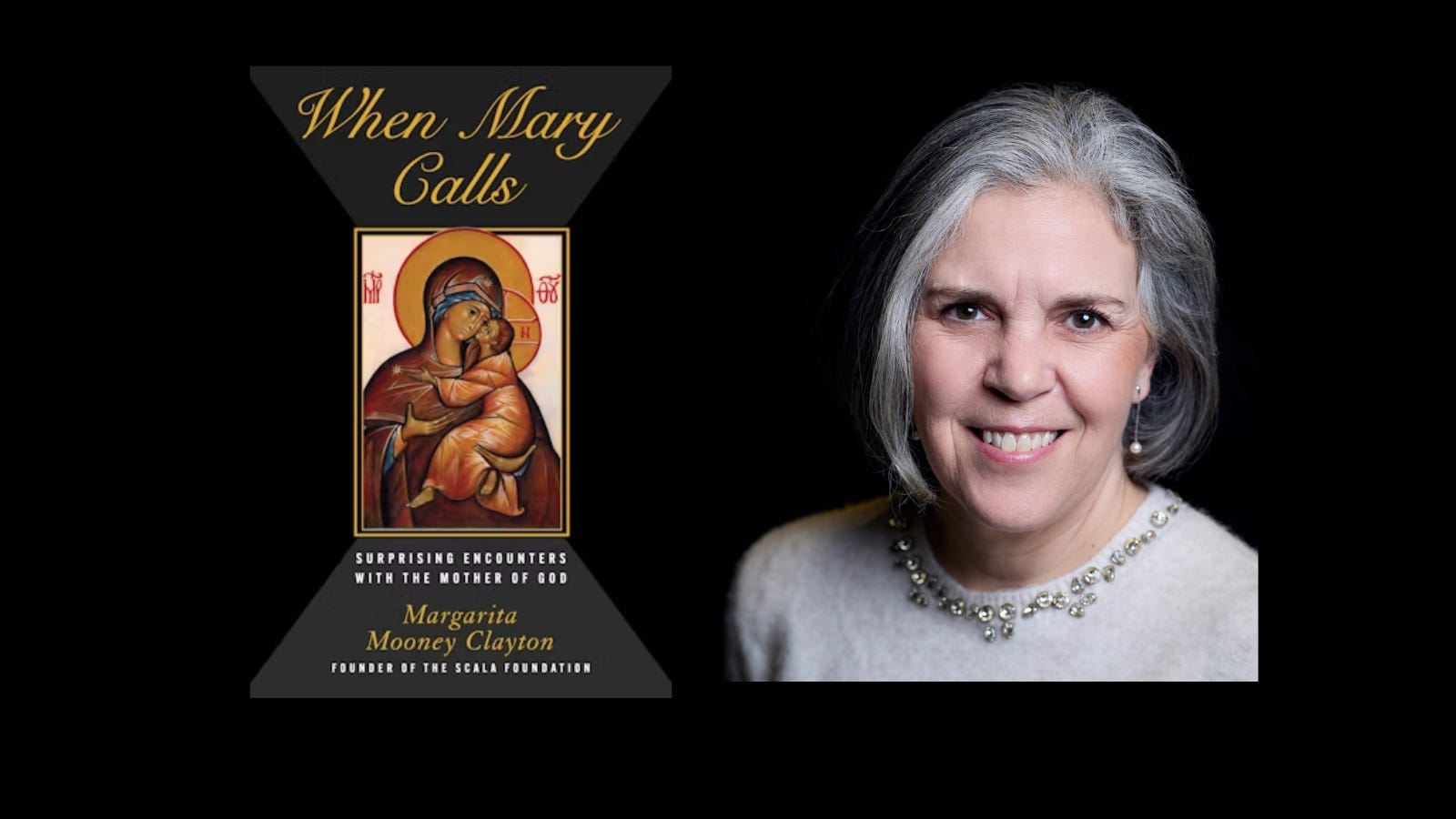
In this month of May, we invited Dr. Margarita Mooney Clayton, a professor at Princeton Theological Seminary, founder of the Scala Foundation, and a research fellow in theology and the arts at Blackfriars Hall, Oxford University, to join us on Conversations with Consequences and discuss her new book: When Mary Calls, Surprising Encounters with the Mother of God. In it, she explores the contemporary and often miraculous influence of the Virgin Mary, through a series of seven spiritual memoirs and interviews.
Here are some highlights of our illuminating conversation. It has been edited for length and clarity.
Betsy Fentress: To what do you attribute both Protestants and Catholics praising this book?
Margarita Mooney Clayton: Well, to put it simply, Mary is alive and she’s moving in the world right now in unexpected ways, which historian Peter Brown can recognize and call an ancient healing well reaching out to a desiccated culture, or which a former Orthodox turned Protestant, Eric Metaxas, can realize that skeptics have long questioned the place of Mary in Christianity, but she has been a presence with the saints and with the faithful. Mary has been close to the people of God since not just the birth of Christ and his crucifixion, but right there in Acts of the Apostles, generating hope in times of fear for the church and really binding the apostles and the followers of Christ together into a family.
Ashley McGuire: So, I’m a Protestant who became Catholic and like so many Protestants got tripped up on some of the Mariology. I never really was against it and never really understood it. I went on a trip to Rwanda with a Protestant group and joined a dinner with a Catholic pilgrimage group led by Immaculée Ilibagiza. She started telling me about Our Lady of Kibeho, and that people were actively having visions of her. How have you highlighted some of these things mystical encounters with Mary right now?
Margarita: There have been powerful apparitions of Mary, Kibeho in Rwanda, Our Lady of Zeitoun in Egypt, not to mention Fatima and Lourdes. For Protestants, the hesitation when you talk about those apparitions is well, can’t people be fooled? Can’t there be demonic influences or false apparitions? And if you look at the history of the Catholic Church, it’s always been recognized that a personal revelation from Mary doesn’t make it authentic or authoritative. But we don’t want to fall into the error of rejecting the possibility that Mary does have a personal message for individual people and for our culture.
Two of the people I spoke to [for my book] were Protestant and had a miraculous healing through Mary. And this was as much a shock to them as it is to listeners, because they weren’t actually looking for it.
But they recognized that there was a maternal embrace reaching them, in one case, spiritual healing, and the other a physical healing. And they didn’t know what to make of it. And they came to me as a Catholic to ask, how is it that I, a faithful Protestant, can’t tell you anything about Mary? And why doesn’t my church ever mention this?
This is part of what the book is trying to do, to show that these miraculous healings which these young Protestants experienced through Mary bound them even tighter to the Church and to Scripture, but in ways which they as Protestants had never seen because of a skepticism about Mary or frankly, a rationalism that says let’s not talk about the miraculous because we can be deceived by it.
The miraculous, as in Mary’s life, has to give way to the ordinary, but we don’t want to neglect Mary’s extraordinary power.
Betsy: You were born and raised Catholic, but admit that Mary hadn't played a large role in your life until you went to Cuba on a clandestine mission with your mother. Talk about going there and seeing the destruction of the Church and what was going on beneath the rubble.
Margarita: As a very young girl, I went to Catholic school and Marian devotion was part of our catechism, it was part of our Sunday liturgy, so I always had Mary. But when I went away to college at Yale, you start to think that in order to be a Christian in the academy, you have to be able to know how to defend every doctrine and have big intellectual ideas and that sort of childlike trust in Mary is for people who don’t have the chance to study or something like that.
I began to appeal to Mary for protection rather instinctively while carrying a suitcase into Cuba—where my mother is from—that was stuffed full of rosaries and DVDs for catechism, Bibles, all kinds of prohibited things.
I first went in ‘94, but this trip I write about in the book, when I almost got caught, was in 2005. And I had seen in those 10 years and seven trips later a society built on atheist communism. In my mother’s school of the Sacred Heart in Havana, they ripped out the Sacred Heart of Mary and Jesus and put in its place two angry men wearing camouflage—Fidel Castro and Che Guevara—and replaced “To Jesus through Mary” with “Fatherland or Death.”
What shocked me, having seen that desecration in my mother’s village, was that not only had they saved images of the people who they were told to forget, like my mother, but someone had saved two stained glass windows of Jesus and Mary in his backyard, hoping and praying that someday those windows would be restored into the church and the church would open again. And the heroic courage and hope to do that really struck me.
But there I was, the Yale and Princeton educated person thinking, I’m going to go into Cuba and bring in money and restart the economy, or something like that. Whereas my mother, one of 14 children, mother of four children, spiritual mother to countless people, what she had was compassion. And she went door to door, listening to people’s stories, embracing people, hearing stories of despair. And I saw in that motherly love that she had an image of Our Lady who can hold all of the pain in the world and say, “Well, I’m here. And if you ever want to come to church again, I’ll walk with you there.”
So that desire for Christ and reverence for his Mother were knit together in people’s hearts. And I realized, who am I to say the faith is not essential? The people in Cuba didn’t want Christ without the Church or Christ without the Mother. And it just dawned on me, well, if you look at the Scriptures, there is no Christ, there is no Incarnation, there is no hypostatic union of a divine nature with a human nature without Mary’s human nature.
Ashley: Beauty and art and how some people encountered Mary through them is a theme in your book. We try to take our kids to a lot of museums. And the other day at an exhibit I said to them, “What do your eyes tell you? How could there be this much beautiful art depicting Mary if she was not an essential part of not just Christianity, but of culture?” What is the role of beauty and art in an encounter with Mary?
Margarita: One of the personal stories that I share is that in part, I had drifted into a very intellectual faith and I was a single, unmarried woman until the age of 48 when I thought during those years, Well, if God hasn’t blessed me with a husband and children like I desired, maybe this whole motherhood thing— it’s not for me. But I ended up a wife, and a stepmother, at the age of 48.
I married a wonderful man, David Clayton, who studied physics at Oxford and then became an iconographer. I was starving inside for the things that I loved as a little girl—music, art—but I’d never been taught how to integrate the experience of art and music with my intellect and my faith. I was raised Catholic, so of course it was there. But when I met my husband who had studied iconography and we began to talk about the liturgy and worship—we talked about the basic fact that Catholic worship is fully embodied and goes through all the senses.
But what I realized from iconographers like David and Aidan Hart is that—that’s why we depict Jesus—because he was a person. He was a human being, he had a face. In the Church we need to depict Christ and his Mother so we remember that they’re persons who are still alive in a transfigured state, which is why traditional iconography doesn’t look like a portrait. It’s not that they don’t know how to draw, but they’re drawing a person in their likeness, but with the mystery of that transfigured person because they’re now in another realm.
I’ve taken students to an Eastern Rite Catholic Church, St. Mary’s Byzantine Catholic Church in Hillsborough, New Jersey. And some of them have never been in a church with images. But several of them have such a direct encounter with Christ and Mary in the images that they are absolutely taken into this kind of window to heaven. And I saw for people who have no exposure to art in church, the direct encounter with Christ and his Mother that can come through these powerful images.
I have prayed the Rosary with Anglicans in England. The Shrine of Our Lady of Walsingham has reformed Catholic and Orthodox going. There’s actually a revival in certain places of Europe with Mary as an image of the patroness of the nation in places where these pilgrimages and superstitions and all of that were actually squashed out by legal decree. We have people going back to some of these older European sites of Marian devotion and recovering the place of Mary.
She is the visible enculturation of the faith across culture and across nations. And this is why she’s depicted in Chinese sacred art, Japanese sacred art, because we are the body of Christ, we are the family of Christ, and we have different faces. So Mary helps, again, embody this incredible truth that we have unity in diversity.
Ashley: One of the most powerful stories in your book is about Tammy Peterson, who many people have come to know through her husband Jordan. She had an incredible conversion. Can you talk about that, and what was it like to interview her?
Margarita: I became friends with Tammy because of her newfound interest in Catholicism, which came really through Mary. I first met her just a couple of months after she received confirmation in the Catholic Church. And what really struck me when I interviewed her was she has this maternal, warm presence.
But what got me about her story is that she really resisted. She had a miraculous healing in the hospital from cancer. She learned to pray the rosary. She was reading Scripture, but she didn’t want to join a church initially because she struggled with the whole concept of authority. But at some point, she realized, as she describes to me, that in order to keep alive that exuberant faith and hope that she encountered in her miraculous cure from cancer, she needed to commit to daily practices.
And then she realized that to keep up those daily practices, she needed community. And then she realized that community has hierarchy, and it has authority, and that she couldn’t just stay on the margins of church and community authority because it didn’t suit her personality. So she gave herself the task of meeting a Catholic priest who guided her section by section through the Catechism. And she found, actually, that every single line of the Creed was something that she could understand and affirm. And so she says that Mary led her to Christ, and that that desire to know Christ led her to the Church and led her to the Catholic Church with its creeds and with its sacraments.
Betsy: Tammy Peterson has featured you on her podcast. In one episode, as a little girl, she recalls thinking, "Where is Mary?"
Margarita: Yes, and that she needed Mary because she needed Mary’s maternal presence to understand that as a woman and a mother that her sacrifices were really meaningful to God. That blew her mind. She practiced New Age, kind of Buddhist-inspired meditation, but there’s frankly no dignity of motherhood or the body. It’s about escaping the body, and so Mary’s maternal embodiment resonated so much more with the bodily sacrifices that mothers make of giving birth, but also of giving up sleep and of nursing a sick child, giving up a career, giving up the capacity to earn money. And here’s Christianity telling her that all of those sacrifices are a sign of love and that is exactly what God has called her to do.
And she never felt worthy for having made those sacrifices. And she says it’s because she had imbibed New Age spirituality with feminist politics that [said] if you don’t have a public influence, you’re nothing. She really struggled with that. And her mission is now to reach women who maybe got pulled in through one or another understanding that to be a real woman is to have kind of public power, and to realize that that’s great if you that’s what God’s calling you to, but the power of motherhood and the private, simple acts of everyday love and obedience, Scriptures tell us, is more powerful than the public power.
